
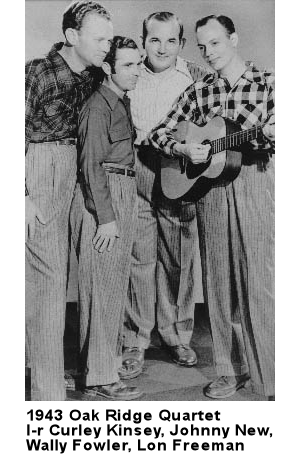
 Group MembersTenor |
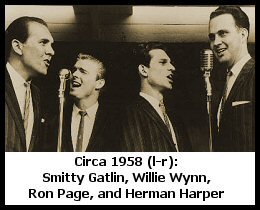 Oak Ridge Boys (1958) |
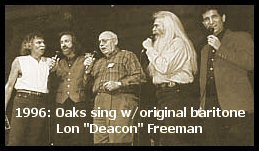 Oak Ridge Boys (1996) |
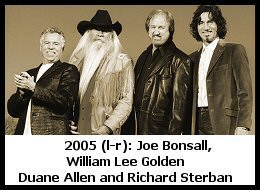 Oak Ridge Boys (2005) |
The Oak Ridge Boys (1943-present)
History
Origins
The roots of the Oak Ridge Boys date back to a group originally known as Wally Fowler’s Georgia Clodhoppers. The town of Oak Ridge, TN drew national attention after the atomic bomb was dropped on Hiroshima, Japan in August 1945. Fowler, whose group had been popular in the area since 1943, subsequently re-named the group after the town. After the name change, they were known as the Oak Ridge Quartet, but they also referred to themselves as the “Oak Ridge Boys” dating back to the early 1950s.
Starts and Restarts
Over the next 20 years, more than 30 members passed through the group including Lon "Deacon" Freeman, Calvin Newton, Joe Allred, Cat Freeman, and a teen-aged Glen Allred. Fowler launched a group called the Oak Ridge Quartet at least four times. The 1943 group left Fowler en masse to form the Stone Mountain Quartet around 1949.
Fowler hired Bob Weber's Statesville, NC based Calvary Quartet to carry on the Oaks name, then transferred the ownership of the group to Weber in 1952 to settle a debt. Fowler continued to book the Weber-owned group at his concert events. Although some of their recordings still included Fowler's name, Calvin Newton was actually singing lead. It was during this period that the Oak Ridge Quartet introduced their famous routine, "Go Out To The Program," a crowd-pleasing segment of their show where they would spoof the popular songs of other groups. The Weber-owned group disbanded in 1956.
Within weeks, Fowler reclaimed the group name and launched a third lineup. This time, it was lead singer Smitty Gatlin and the Country Boys who became the new Oak Ridge Quartet. Ronnie Page sang baritone with the new 1956 group. History repeated itself in 1958 when Gatlin and the members of the third group secured ownership of the group name from Fowler. As before, it was to settle a debt. With the addition of tenor Willie Wynn, bass Herman Harper, and pianist Tommy Fairchild, they became one of the most popular quartets of the early 1960s.
By this time, the group was known and marketed as the Oak Ridge Boys, so Fowler started a fourth group and again named it the Oak Ridge Quartet. A lawsuit filed by the Oak Ridge Boys in 1964 was settled in favor of the group in 1965, forcing Fowler to stop using their name.
Success in Gospel Music
During the 1960s, the Oak Ridge Boys had their own television program geared for youth called It’s Happening. They continued to perform “Go Out To The Program,” updating it with different songs from time to time. In one skit, for example, tenor Willie Wynn and the Oaks would sing the song “Higher” in the style of Rose Carter Karnes of the Chuck Wagon Gang. This was especially popular on multi-artist events, because the artist they were spoofing would often join them on stage to the delight of the crowd.
When Smitty Gatlin left the group a few months after the resolution of the lawsuit with Fowler in 1966, Duane Allen was hired to take his place. William Lee Golden was already singing with the group by this point, succeeding baritone Jim Hamill in 1965 who succeeded Gary McSpadden in 1964. Noel Fox replaced Herman Harper at the bass position in 1969.
The Oak Ridge Boys of the late 1960s and early 1970s were one of the more progressive groups in gospel music and had a very polished sound. They appeared on the Johnny Carson Show in 1968 and again in 1969, then on the Johnny Cash Show in 1971. This recognition by the mainstream entertainment industry began nearly a decade before the Oaks made a deliberate shift away from Gospel into Country music.
In January of 1970, the Singing News magazine began publishing a monthly radio airplay chart. The Oak Ridge Boys had the very first number one song with “Jesus Is Coming Soon.” At that time, there were several recordings of this very popular song, so this honor was actually shared with three other groups in 1970. "Jesus Is Coming Soon" held the number one position for three months and returned to the top of the chart for another three months later that same year. The Oaks had another number one in October of 1970 with “Sheltered In The Arms Of God.” Then they dominated the top of the chart in 1971 with the song “I Know” staying at number one for ten months. “The Flowers Kissed The Shoes Jesus Wore” (April 1972) and “King Jesus” (October 1973) were also number one songs on the Singing News chart for the Oaks.
The 1970s: Moving from Gospel to Secular
Duane Allen and William Lee Golden got to know Joe Bonsall and Richard Sterban in the late 1960s and early 1970s. When bass singer Noel Fox left the group in 1972, Sterban was hired as his replacement. Sterban had been singing bass for JD Sumner And The Stamps Quartet and touring with Elvis Presley. Bonsall joined in 1973, replacing the 15-year veteran tenor Willie Wynn. Both Sterban and Bonsall were former members of the Keystone Quartet, which had covered songs popularized by the Oaks.
The Oaks continued to sing gospel music, but their increasingly progressive stage presence had begun to worry some promoters. Many fans were bothered as well. 200 people stood and marched out in protest when they performed in Roanoke, VA in 1975, an act the Oaks accused the Kingsmen Quartet of putting into motion, but the Kingsmen denied. Former Oaks baritone and Kingsmen member Jim Hamill was particularly outspoken about the direction the Oak Ridge Boys were going at this time, referring to them as a “night club act.” Florida Boys manager Les Beasley also went public with his criticism of the Oaks. While praising the image of the Statler Brothers, Beasley said they weren’t “Oak Ridge types.”
The full shift to secular was completed when the Oak Ridge Boys were booked to open a tour for Roy Clark and were told they were just “three minutes” away from making it big in Country music…that is to say, they had everything they needed to succeed in terms of talent and stage presentation except one big hit song. After a couple of lean years attempting to break into the industry on the Columbia label, the Oaks had success with their 1977 MCA album called Y’all Come Back Saloon. Any lingering doubts about whether or not the Oaks were switching to secular were resolved at that point.
Secular Successes
A string of hits in the late 1970s and 1980s established the Oaks as one of Country music’s top vocal group. With novelty songs like “Elvira” and “Bobbie Sue” and a Gospel/Christmas/Country genre-crossing classic in “Thank God For Kids,” their popularity soared to new heights. Fancy Free (the album featuring "Elvira"), was eventually certified Double Platinum by the Recording Industry Associaton of America (meaning more than two million units were sold). "Thank God For Kids" appeared first on their holiday album titled Christmas, and later on numerous compilations of past Oak Ridge Boys hits.
The first thirty years of the Oak Ridge Quartet/Boys saw many singers come and go, but once Joe Bonsall joined in 1973, the group stabilized. Baritone William Lee Golden left the group in 1987 after a twenty-two year tenure. Regarding Golden's departure, Joe Bonsall would later write, "I am sorry that we ever stretched our brotherhood and friendship to the breaking point from 1985 through 1987" (An American Journey, pub. 2004). Rhythm guitar player and backup vocalist Steve Sanders took Golden's place and the group enjoyed continued success on the Country charts for the next few years. Sanders left the group suddenly in November of 1995. Dee Allen (Duane Allen's son) and former Exile singer Paul Martin filled in temporarily through New Year's Eve, when William Lee Golden resumed the baritone role. According to Bonsall's account, the Merriville, Indiana crowd stood and applauded for ten minutes when they realized Golden had returned.
New Southern Gospel Recordings
In 1997, the Oak Ridge Boys released a 2-volume recording of Gospel songs titled Revival. This release was not widely distributed, but it signified a return to recording Gospel music and turned out to be a sign of more to come. In 2001, the Oaks signed a recording contract with Spring Hill and released From The Heart, a Southern Gospel album produced by Duane Allen and Michael Sykes. This CD contained several new gospel songs in addition to classics like "Workin' On A Building" and "Angels Watching Over Me." Around this time, the group began to be featured on the Gaither Homecoming videos. They also established a daily show at the Grand Palace in Branson, MO where they appeared for several months each year.
The Oaks released several thematic CDs after joining the Spring Hill label, including several Christmas titles, a patriotic recording, and a bluegrass project. More all-gospel CDs have followed as well. In June 2008, their Southern Gospel single "Didn't It Rain" appeared on the Singing News monthly chart, acknowledging that DJs in the Southern Gospel industry were playing the song. They also released a live Gospel video with Bill Gaither and some of the Homecoming Friends in 2009 titled A Gospel Journey.
The group has also continued to record material aimed at the secular market for the Spring Hill label. 2009's The Boys Are Back featured a cover of the White Stripes' song "Seven Nation Army." The Oaks typically perform a mix of their past hits, current new recordings, and several gospel songs at their concerts.
In 2023, The Oak Ridge Boys announced their American Made: Farewell Tour. The announcement coincided with the 50th anniversary of Joe Bonsall joining the group, with official branding celebrating "50+ years of touring," and was planned to last at least into 2024. In early January 2024, the group announced Joe Bonsall had left the group in late 2023 due to a neuromuscular disorder that had progressed to the point where he could no longer walk. Ben James replaced Bonsall for the final appearance of 2023. The announcement stated that James would continue to perform with the group for the remainder of the Farewell Tour. Since that time, the Farewell Tour has been extended indefinitely, with James continuing as a full-fledged member of the group.
Awards
Dove Awards
Album Of The Year - It's Happening (1969); Light (1972); Street Gospel (1973)
Album Jacket - It's Happening (1969)
Backliner Notes - Light (1972)
Country Album Of The Year - From The Heart (2002)
Country Recorded Song Of The Year - "Jonah, Job And Moses" (2007)
Country Song Of The Year - "Sweet Jesus" (featuring Merle Haggard) (2015)
Cover Photo Or Cover Art - Street Gospel (1972); Old Fashion, Down Home, Hand Clappin', Foot Stomping, Southern Style, Gospel Quartet (1976)
Graphic Layout And Design - Street Gospel (1973)
Long Form Music Video Of The Year - A Gospel Journey'' (2010)
Male Group Of The Year (1970, 1972)
GMA Hall Of Fame (2000)
Singing News Fan Awards
Favorite Group (1971)
Discography
(Ed Wille of www.oaksdiscography.com graciously assisted us in completing this extensive discography.)
We need years for the following titles:
???? Keep Walking
???? Gospel Volume 5 (Out Of Town Records)
Due to the large number of projects recorded by the Oak Ridge Boys, the discography section has been divided into separate pages by decade to allow for easier loading and viewing. Please click on one of the links below for the decade you wish to view.
1950s 1960s 1970s 1980s 1990s 2000s 2010s 2020s